
Isolation failures oftentimes don’t usually start with a defective valve — they start with a misunderstanding of how the isolation configuration behaves under pressure. A valve expected to isolate, doesn’t. Not because the equipment was poorly manufactured, but because the internal seat design wasn’t suited to the pressure conditions in the line.
Across the oil and gas sector, Double Block and Bleed (DBB) and Double Isolation and Bleed (DIB) are still used interchangeably, even though their sealing mechanics are fundamentally different. That mix‑up can introduce leak paths, loss of isolation, and avoidable operational risk, particularly in buried or long‑life service where reliability is non‑negotiable.
Understanding the distinction between DBB and DIB — and how each configuration responds to pressure — is essential for selecting an isolation valve that maintains integrity not just at commissioning, but throughout decades of operation.
Double Block and Bleed vs. Double Isolation and Bleed – Is There a Difference?
Double Block and Bleed Explained
According to API 6D (2025), Section 3.1.15, a Double Block and Bleed (DBB) valve is defined as:
“Valve with two or more sealing surfaces that, in the closed position, provides a seal against pressures from both ends of the valve with a means of venting/bleeding the cavity between the seating surfaces.”
A Double Block and Bleed (DBB) valve uses single‑piston‑effect (SPE) seats, which are spring‑loaded and rely on upstream pressure to push the seat against the ball. Because SPE seats are self‑relieving, they only seal when pressure is applied from their upstream side. If pressure exists on only one side of the valve, only that seat will seal—the opposite seat will not hold isolation.
If the upstream seat leaks, the downstream seat cannot maintain a seal in the same direction. This results in loss of isolation during maintenance or shutdown, allowing media to continue moving down the line when the system is expected to be safely isolated. DBB valves can be suitable for non‑critical service, but they do not provide the level of isolation many engineers expect for critical services. In applications where isolation integrity is essential — buried pipelines, high‑pressure systems, hazardous fluids, or long‑term installations — this limitation becomes a significant concern.
Double Isolation and Bleed Explained
API 6D (2025), Section 3.1.16 defines a Double Isolation and Bleed (DIB) valve as:
“Valve with two or more seating surfaces, each of which, in the closed position, provides a seal against pressure from a single source, with a means of venting/bleeding the cavity between the sealing surfaces.”
Double Isolation and Bleed (DIB) valves are designed to provide a higher level of isolation than a traditional DBB configuration. API 6D defines two types of DIB valves: DIB‑1 and DIB‑2. Before breaking down these categories, it’s important to understand the principle behind double‑piston‑effect (DPE) sealing.
A double‑piston‑effect seat seals against the ball regardless of where the pressure originates. Whether pressure is coming from the upstream side, the downstream side, or building in the cavity, a DPE seat continues to seal against the ball and maintain isolation. This is fundamentally different from a single‑piston‑effect seat, which only seals when pressure is applied from its upstream side.
DIB‑2 valves combine one double‑piston‑effect seat with one single‑piston‑effect seat, making the valve unidirectional. Double isolation is achieved only when pressure is applied in the direction supported by the DPE seat.
DIB‑1 valves use two double‑piston‑effect seats, allowing the valve to maintain isolation regardless of which side the pressure comes from. Because both seats are DPE, DIB‑1 valves are bidirectional, providing double isolation in either flow direction.
The Case for DIB‑1 in Critical Isolation
In applications where isolation integrity is critical, the ability to seal from either direction becomes a defining requirement. That’s why DIB‑1 valves, with their two double‑piston‑effect seats, are increasingly preferred for buried service, high‑pressure systems, and long‑life installations where operators cannot afford loss of isolation.
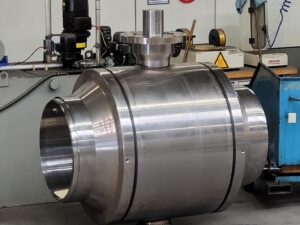
Boehmer’s fully welded ball valves are built as true DIB‑1 valves, using double‑piston‑effect seats on both sides of the ball. This allows the valve to maintain isolation regardless of where pressure originates — upstream, downstream, or in the cavity — providing a level of reliability that traditional DBB configurations simply cannot achieve.
Manufactured in Germany with a fully welded, forged body and precision‑machined components, Boehmer valves are known for their robust construction, exceptionally low leakage rates, and maintenance‑free double‑piston‑effect seats — a combination that supports reliable isolation performance over decades of service.
As operators place greater emphasis on long‑term reliability, buried service performance, and predictable isolation behavior, the industry continues to move toward DIB‑1 designs for critical applications. This is where Boehmer’s fully welded, DIB‑1 ball valves align naturally with operational needs — offering bidirectional double isolation, robust seat performance, and lifecycle integrity that supports decades of service.